


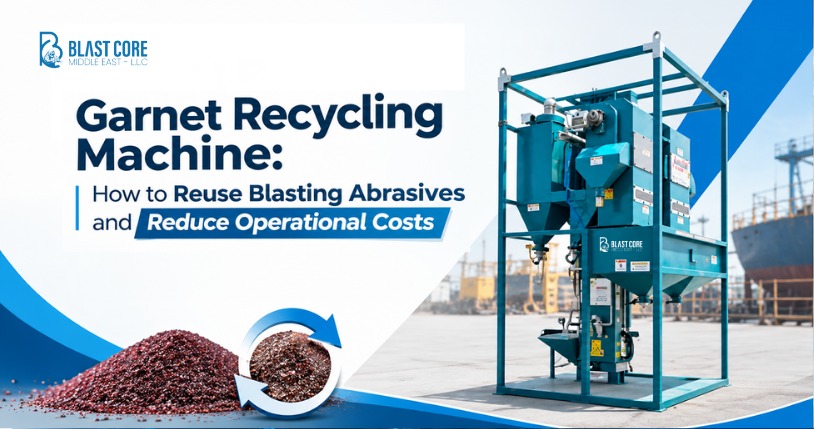
One of the highest consumable costs for fabrication yards, shipyards, and industrial coating contractors is abrasive blasting. The majority of this expense is for single-use blasting. Garnet is a hard, dense mineral that can be recycled multiple times provided it is properly collected, cleaned, and graded. That is what a garnet recycling machine can do, and it can make an ongoing cost,a cost to be managed and predicted. Here we can outline the process of recycling garnet, the savings, and what to consider before investing in a system.
Why Garnet Is Worth Recycling
Garnet is used for surface preparation due to its low free silica content and hard, angular characteristics. It cuts through rust, mill scale, and old coatings easily. It also has a higher density than lower-density abrasives, which means that many of the grains will not break on the initial impact and can be reused. That remaining life is wasted with single-use blasting. Both used and reusable abrasives are swept away and disposed of with spent abrasive. Recycling recovers it.
How a Garnet Recycling Machine Works
The important thing to remember is that worn grains can never be new grains. It gets rid of the non-functioning grains, thus ensuring uniformity in the abrasive that is returned to the pot.
- Recovery: Spent abrasive is retrieved from the blast area by mechanical conveying or by vacuum recovery.
- Debris Separation: Screens filter out large debris like paint flakes, scale, and packaging.
- Air-wash Cleaning: A controlled airflow removes the dust and fines that are lighter than the reusable grains.
- Size Classification: These grains are classified by size after being cleaned. Grains that are still usable are returned to the storage hopper, and those that are too small are discarded.
- Return to the Blast Pot: Clean, correctly graded abrasive is fed back into the blasting system.
How Many Times Can Garnet Be Reused?
There's no one number. The number of reuses is dependent on the grade of garnet, the blasting pressure, the surface to be cleaned, and the tuning of the recycler. Grain is broken down more quickly on hard surfaces and under high pressure. Lighter work and well-balanced separation prolong life. Always give any supplier's re-use percentage as a range, and request the qualifying conditions.
Where the Cost Savings Come From
To estimate your own return, compare your current monthly abrasive spend and disposal cost against the system price, expected operating cost, and realistic recovery rate. Savings vary by workload, so calculate with your own numbers rather than general claims. Savings come from several places, and they add up over time:
- Lower abrasive purchases: Reusing garnet reduces how much fresh material you buy for each project.
- Reduced disposal volume: Less spent abrasive means fewer waste loads to haul and handle.
- Less labor on cleanup: Automated recovery cuts the time crews spend sweeping and bagging.
- More consistent finish quality: Removing dust and fines helps maintain a stable surface profile, which can reduce rework.
- Fewer interruptions: Continuous feed means less downtime for refilling.
What Safety Measures Are Required for Garnet Abrasive Recycling?
Recycling also contributes to better management of safety and cleanliness. The removal of fine dust by air washing technology prevents it from remaining in the working area, while the enclosed recovery process reduces airborne particles. Another property of garnet that makes it desirable to some operators is its low free silica content.
Despite this, however, the spent abrasive may contain contaminants from the surface blasted, including old coatings or heavy metals. Dust control, operator protection, and waste disposal should be implemented according to local regulations, in accordance with the guidance of your safety officer. Look at the criteria that are relevant to your site/industry in the UAE.
How to Choose the Right Recycling System
Before buying, evaluate these points:
- Capacity: Match throughput to your blast pots and number of operators.
- Separation quality: Ask how well the machine removes fines and contaminants.
- Build and wear parts: Abrasive is harsh on equipment, so check the materials used in high-wear areas.
- Dust collection: Confirm that filtration suits your site and environment.
- Mobility and layout: Fixed blast rooms and open-site work need different setups.
- After-sales support: Spare parts availability and technical service affect long-term uptime, especially in hot, dusty conditions.
How to Get Better Results from Garnet Recycling
- Keep abrasive dry because moisture causes clogging and poor separation.
- Inspect and replace screens and wear parts on a schedule.
- Monitor grain size regularly and top up with fresh garnet in small, steady amounts.
- Train operators to recognize when abrasive quality is declining.
- Record consumption and disposal figures so you can measure actual savings.
Ready to Reduce Blasting Costs with Garnet Recycling?
The garnet recycling machine recycles the abrasive materials that are usually discarded, which reduces material and disposal costs and ensures consistency during surface preparation. The outcome is determined by selection of the right capacity, maintenance of equipment, and monitoring of abrasive quality. When you need a garnet recycling machine in Abu Dhabi, BlastCore Middle East will be able to help you evaluate your blasting operation and choose the right blasting system for your job. Connect with a reputable team with your current abrasive usage and project type to get a recommendation based on your actual operation.