


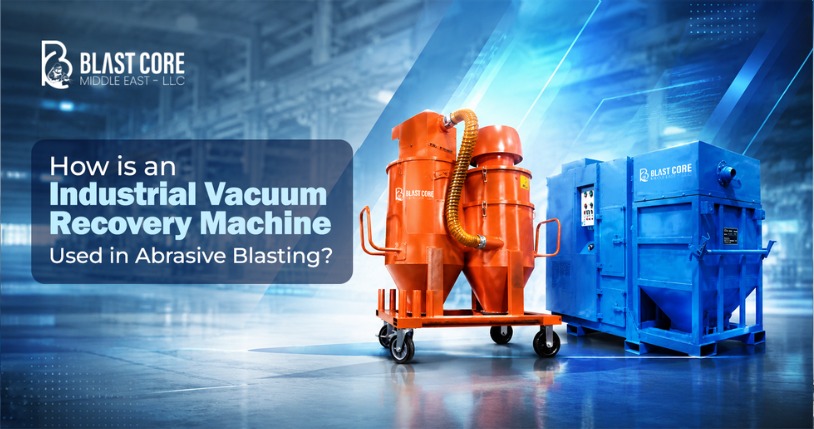
Every blasting job leaves behind a mess, spent abrasive, dust, and debris spread across the work area. Cleaning it up manually is time-consuming, costly, and hazardous. That is where an industrial vacuum recovery machine changes the game. These machines help in recovering spent abrasives, cleaning it, and returning it to service with minimal downtime. If your operation is done through garnet or steel grit at scale, understanding how this equipment works is the most essential thing.
What is an Industrial Vacuum Recovery Machine?
An industrial vacuum recovery machine is a machine that uses power to collect, separate, and remove used abrasive media from blasting surfaces and recycle them. The machine is built to collect used abrasive instead of sweeping it into waste bins. Then, it separates out the dust and debris, keeping the reusable media for future deployment.
These machines are used in shipbuilding, oil and gas, marine maintenance, infrastructure construction, and heavy fabrication. This technology is beneficial to any surface preparation job that involves a high rate of abrasive usage and requires frequent surface preparation. The economics are clear: Abrasive materials such as garnet and steel grit can be very costly, and by recovering 70-80% of spent media, procurement costs can be significantly cut.
Essential Parts of an Industrial Vacuum Recovery Machine
There are five main components to a standard industrial vacuum recovery machine, which include:
- Abrasion Cleaning Cycle: The action of particles that is carried out once the airflow is generated by the vacuum unit.
- Cyclone Separator: This helps to separate heavy particles from fine dust by centrifugal force, using the principle of rotating the mixture of air and abrasive.
- Dust Collecting System: Collects the UFD before the clean air is exhausted.
- Screening/grading deck: Removes oversized contaminants and breaks in the media.
- Collection Hopper: Abrasive that has been cleaned and is ready for use in the next blast cycle.
How Vacuum Recovery Machines Work
- Suction: The operator moves a recovery nozzle over the blasted surface. The vacuum then collects used abrasive, dust, and debris from the area.
- Separation: The materials collected are fed to a cyclone chamber. The centrifugal force process separates the heavier abrasive particles from the lighter dust and contaminants. Dust is blown to the filter unit, and abrasive drops into the screening system.
- Screening: The abrasive is forced through a graded screen, which eliminates large particles, broken pieces, and foreign things. Only media in the acceptable size range is allowed to continue.
- Recovery: The hopper is cleaned, and the abrasive is gathered and fed back into the blast pot for reuse, and the cycle is complete.
This process is done in parallel to active blasting on large blast yards, avoiding the need for long cleanup downtime.
Benefits of Using Industrial Vacuum Recovery Machines
Abu Dhabi's industrial sectors include petrochemical plants, shipyards, desalination facilities, and offshore infrastructure; all of these run some of the most abrasive-intensive surface preparation programs in the region. There is a need to recycle garnet in a specific way, which the garnet recycling machine in Abu Dhabi is solving. Garnet is a high-quality abrasive that is expensive but can be used to provide a lower dust profile and higher cutting speed. The use of recovery machines increases the useful life of each batch and decreases the procurement frequency.
A grit recycling machine is also a key machine for steel grit blast yards in Abu Dhabi when operating at large volumes. Steel grit is durable and can be recycled, but only if the system of recovery and grading is right. As more and more local environmental regulations are put in place to control the handling of spent abrasive waste, recovery machines are becoming a compliance requirement, as well as a financial proposition.
How to Select the Right Industrial Vacuum Recovery Machine?
Choose the machine according to your needs. Machines include project size, abrasive type (garnet, steel grit, copper slag), throughput in kg/min, dust extraction capacity, and maintenance accessibility. Portable units are appropriate for smaller jobs, and centralised units for large blast bays. Specs matching demand, not necessarily the most powerful, provide the greatest ROI.
All Together
An industrial vacuum recovery machine is one of the smartest investments a blasting operation can make. It reduces material waste, lowers costs, improves safety, and keeps projects on schedule. In Abu Dhabi's industrial environment, companies use large amounts of abrasive media and must meet strict industry standards. As a result, recovery technology has become an unavoidable part of efficient operations.
In Abu Dhabi, a trustworthy brand like Blastcore Middle East can supply industrial-grade garnet and grit recycling machines. Choosing brands like this is the best option because their equipments are built for the performance levels that heavy operations demand, making it a trusted partner for businesses serious about efficiency and compliance.